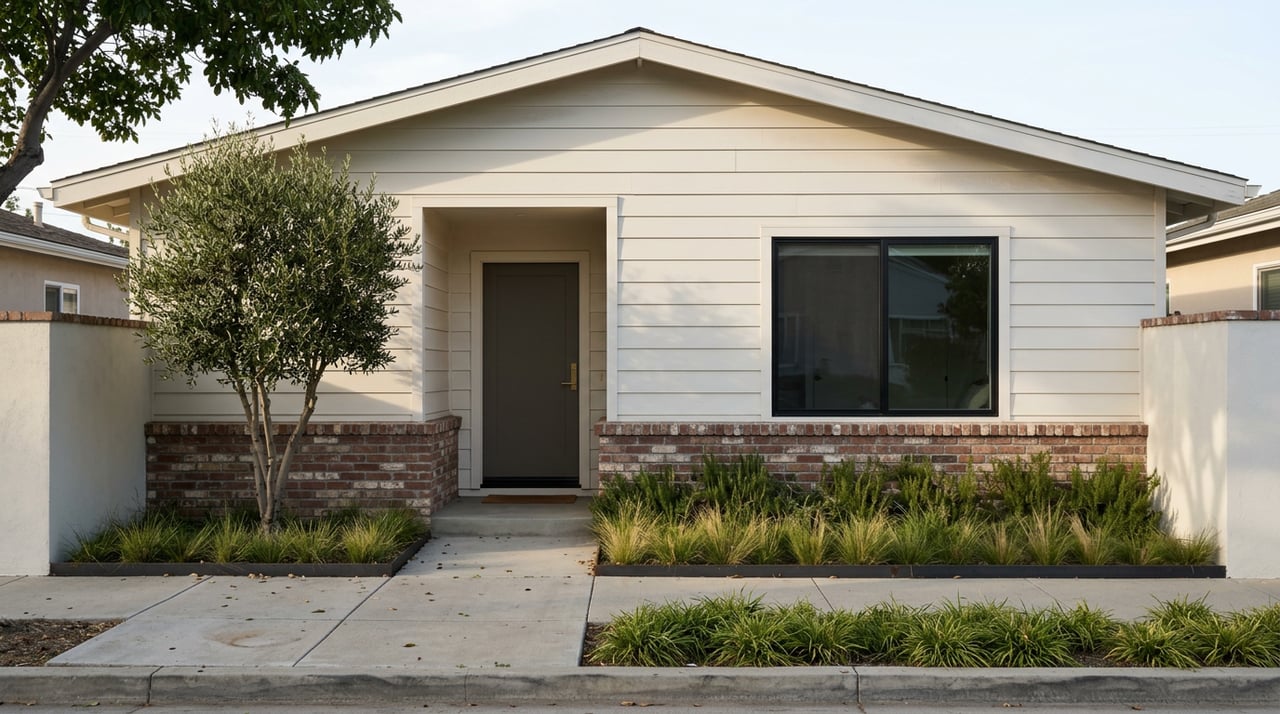
Ask whether Martinez is a buyer's market or a seller's market this summer, and the honest answer is both, depending on which three blocks you're standing on. Every address in the city, from a two-bedroom bungalow near the Amtrak platform to a five-bedroom estate up in the Alhambra Valley hills, files under the same ZIP code, 94553. That single ZIP code is currently home to two housing markets that aren't moving together, and if you size an offer or price a listing off the citywide number alone, you're reading a signal that was never really about your street.
The Number Every Portal Quotes
As of August 2026, Martinez's citywide median time on market sits at 35 days, about 5 percent faster than the same month last year, with a median list price near $848,000. Zillow's most recent citywide snapshot, taken at the end of June 2026, put the average home value at $801,754, down 2.8 percent over the prior year, with homes moving to pending in about 12 days. Redfin's closing data from December 2025 told a slower story: a median sale price of $790,000, down 2.0 percent year over year, with homes taking 60 days to close and only 25 sales that month, compared to 36 the December before.
Stack those three snapshots and the citywide read is consistent even where the exact figures differ. Martinez, taken as a whole, has cooled slightly on price and stretched out slightly on time over the past several months. That's the number a portal algorithm hands anyone who searches the city name. It's also the number that misrepresents a meaningful share of the city's own listings.
Three Blocks From Main Street, a Different Story
Redfin tracks Downtown Martinez separately from the rest of the city, and its most recent read, covering the three months ending May 2026, shows a median sale price of $780,000, up 25.8 percent from the same period a year earlier. Homes in that pocket sold in a median of 17 days, compared to 15 days the year before, which is to say, still fast.
Look closely at the sales count behind that number. Five homes closed downtown in May 2026, down from seven the year before. A 25.8 percent swing sounds dramatic until you remember it's built on five transactions, not fifty. One well-updated remodel closing in a given month can move that median by tens of thousands of dollars on its own. Treat the percentage as a signal about direction and pace, not as a verdict on exact value. What it confirms reliably is that Downtown Martinez is selling faster and pricier relative to itself than the rest of the city is, not the reverse.
Notice something else. The two headline prices, $780,000 downtown and roughly $790,000 to $801,000 citywide, land close enough that price alone won't tip you off to which market you're actually in. It's the direction of travel and the speed of sale that split them apart.
| Snapshot | Coverage | Price | Timing measure | Year-over-year direction |
|---|---|---|---|---|
| August 2026 | Citywide Martinez | $848K median list | 35 days | 5% faster than Aug 2025 |
| June 2026 | Citywide Martinez | $801,754 avg value | ~12 days to pending | Down 2.8% |
| 3 months ending May 2026 | Downtown Martinez | $780K median sale | 17 days | Up 25.8% (5 sales) |
| December 2025 | Citywide Martinez | $790K median sale | 60 days to close | Down 2.0% (25 sales) |
What's Actually Pulling Downtown Ahead
Downtown Martinez has three things going for it that the rest of the ZIP code doesn't share evenly: a walkable commercial core, a working transit connection, and a calendar that keeps drawing people to the waterfront.
The Amtrak Capitol Corridor stop sits downtown, which matters to anyone commuting toward Oakland or Sacramento without wanting to own a second car for it. The waterfront itself, Waterfront Park and the Martinez Marina, functions as both open space and event venue, and the city has been actively investing in that identity this year. Martinez turned 150 in April, and the city is marking it with a Sesquicentennial Festival on August 29, running from 11 a.m. to 7 p.m. across Waterfront Park, Joe DiMaggio Field, the marina, and nearby regional park land, in partnership with the Bay Area Craft Beer Festival. National Night Out brought residents to Waterfront Park on August 4. None of that is background noise for a housing market. It's the kind of recurring civic investment that keeps a downtown feeling worth walking to, which is precisely the quality buyers pay a premium for.
Downtown Martinez & Co, the local business alliance, runs a steady calendar on top of the city's own programming: a year-round Sunday Farmers' Market, an Open Air Market, and seasonal strolls like the Wine & Chocolate Stroll and the Bay Area Craft Beer Festival weekend. Earlier this summer, city officials also began exploring a Downtown Entertainment Zone designation for the Main Street corridor, a discussion that reached the Economic Development Committee in June. That's not a fact that changes a valuation on its own, but it's a signal of where the city is choosing to concentrate its own attention and resources, and buyers tend to notice the same thing agents do: momentum compounds.
Compare that to the rest of the city's residential stock, the Alhambra Valley estates and the broader suburban tracts that make up most of Martinez's inventory. Those homes are larger on average and further from Main Street, and they're the segment most likely to be pulling the citywide median toward flat to slightly down, simply because they represent more of the total sales volume and less of the walkable, transit-adjacent appeal that's driving downtown's run.
Two Portals, Two Different Clocks
Here's a detail worth sitting with before you compare any two market stats side by side. Zillow's 12-day figure measures time to pending. Redfin's 60-day figure, from December 2025, measures time to close. Movoto's 35-day figure sits somewhere in between depending on how it's calculated. These aren't three inconsistent readings of the same clock. They're three different clocks measuring three different points in the same transaction, the moment an offer is accepted versus the moment escrow closes versus a blended average across active listings.
That gap explains why Martinez can look like it's simultaneously speeding up and slowing down. It isn't. The market is doing one thing, cooling gently and unevenly, and the reporting is doing another, measuring that one thing from different angles. Before you compare a days-on-market figure across two sources, or across two neighborhoods, check what each one is actually counting.
What This Means If You're Buying or Selling Here
If your listing sits within easy walking distance of Main Street or the marina, the last several months of downtown data give you real support for pricing at or above recent comparable closings, and for expecting a fast turnaround if the home shows well. Just don't lean on the 25.8 percent figure as if it applies to every block downtown equally. It's a small-sample number, and it can swing hard on a single closing.
If your home sits further out, in the Alhambra Valley or one of the broader residential tracts that make up most of the city's inventory, the citywide figures, the ones closer to flat or gently down, are the more honest benchmark. That's not bad news. It means realistic pricing and patience, not urgency, and it means your comparable sales should come from your own segment, not from a Main Street closing that has little to do with your lot size or your commute.
For buyers, the split cuts the other way. If walkability and a short walk to the Amtrak platform matter more to you than square footage, expect to compete for downtown inventory and move quickly when something comes up. If you have more flexibility on location within the city, the broader Martinez market, the one reflected in the citywide numbers, still has room to negotiate that the downtown data doesn't show.
Our full breakdown of what it's actually like to live across Martinez's different pockets, from commute reality to school boundaries, is in our Martinez resident guide, and current downtown and citywide inventory is searchable directly through our Martinez listings page.
A Few Questions Worth Asking Before You Price Anything
Is Downtown Martinez overpriced right now? Not necessarily. A 25.8 percent year-over-year gain looks steep, but it's built on a handful of sales, and small samples move in both directions quickly. The more durable signal is the consistent 15 to 17 day sale window, which suggests real demand rather than a one-time outlier.
Will this pace hold through the rest of 2026? No one can promise that from five data points, and neither can we. What the numbers show is a clear divergence between downtown and the rest of the city as of this summer. Whether that gap widens, narrows, or closes depends on factors, interest rates, inventory, and how many sellers list in the walkable core, that are worth revisiting month to month rather than assuming forward.
Should I get a citywide comp or a neighborhood-specific one? A neighborhood-specific one, every time. The citywide median is a useful headline, but as this data shows, it can sit within a few thousand dollars of a neighborhood figure while telling a completely opposite story about direction and speed.
If you're trying to figure out which of Martinez's markets your home or your search actually belongs to, that's exactly the kind of read The Lupe Kemper Team does block by block, not ZIP code by ZIP code. Request a Free Home Valuation and we'll show you the comps that actually apply to your address, not the citywide average.